
Arched Window Treatments: 3 Custom Solutions for Privacy & Blackout

The curve at the top is what makes an arched window special. Choosing a treatment, however, takes more than finding something that matches that curve. It also means deciding how the treatment will open, where the fabric will gather and whether light will slip through the joins.
Treating the arch and the lower window separately gives you more decorating flexibility, but introduces a meeting point between two treatments. A one-piece cellular shade avoids that upper-to-lower join, but has its own size limits. Curtains that follow the arch add softness and character, yet they do not slide like drapery on a conventional straight track.
The best arched window treatments bring shape, light control, mounting and everyday use together—before anything is made.
At EaseEase Curtains, we focus on Affordable Custom Curtains & Shades: made-to-measure solutions that work with your home and your budget. Here are three approaches to dressing an arched window, with the practical details that matter most.
1. A Separate Arched-Top Cellular Shade, With Your Choice of Treatment Below
When an arched window has a curved upper section and a rectangular lower section, you can treat them independently. Fit a custom cellular shade to the arch, then choose curtains, Roman shades or another suitable treatment for the window below.
The benefit is straightforward: solve the difficult shape at the top without limiting your options underneath. The entire window does not have to use the same treatment simply because the upper section is curved.
Manual arched-top shades: a two-line suspension design
The manual arched-top cellular design uses two suspension lines to support the shade. Before ordering, confirm the suspension points, window-frame conditions and whether the user can comfortably access the operating position.


Motorized arched top window shades: a top assembly with flexible fixing options
The top ceiling-mount assembly is part of the motorized design. It is not a separate version you choose instead of side-frame fixing or side-mounted brackets.
With that top assembly in place, the fixing method can adapt to the available structure. Where there is no suitable fixing point, the assembly can be secured to the left and right window frames. Where suitable fixing points are available, it also supports side mounting on brackets.
Check the frame depth, secure fixing locations and surrounding structure first. These are flexible installation arrangements for the same design—not three mutually exclusive motorized products.


With two separate treatments, plan the meeting point
Separating the upper and lower sections gives you freedom to mix treatments, but it also creates a join between them. In a bedroom, check whether light could enter at that meeting point rather than assuming that two blackout fabrics will automatically create a dark room.
Keep the treatment below flexible; plan the potential light gap between the two sections from the start.
Explore EaseEase custom arched and specialty-shape cellular shades for a starting point, then have the exact structure checked against your window.
EaseEase arched shades & EaseEase Shangeri-la shades

2. A One-Piece Motorized Half Round Window Shade to Reduce Light at the Join
For an arched window or glazed door that needs continuous coverage—especially in a bedroom where darkness matters—a half round top motorized cellular shade is worth evaluating.
This design travels upward from the bottom, covering the lower glass before extending into the arched section at the top.
The real advantage: no separate upper-to-lower shade join
Both motorized cellular designs in this guide support smart control and scheduling. Smart functionality is not the main distinction between a split installation and a one-piece installation.
The more important difference is structural. A one-piece half round top window shade does not require separate upper and lower shades to meet at the spring line—the point where the straight sides transition into the arch. It therefore removes that particular joint as a potential source of light leakage.
When your concern is “I don’t want a bright line between two shades waking me in the morning,” rather than simply softening daylight, this distinction matters more than the control method.
For a bedroom where you want more complete darkening, assess a one-piece half round top design first, provided the size and shape allow it. For a room where independent styling above and below matters more, separate treatments offer a different kind of flexibility.
Blackout performance depends on the fabric and the perimeter
Eliminating the upper-to-lower join does not guarantee that every installation will be completely free of light gaps. The frame edges, fit around the curve and installation clearances still need attention.
Be specific about the result you need: blackout fabric, with as little light as possible at the center join and around the perimeter. Our technical team can then assess the achievable coverage for the actual window.
3. One Piece or Separate Sections? Compare Size Limits First
A one-piece design for half round windows is not suitable for every size. Width, overall height, arch profile and mounting conditions all affect whether it can be made.
If either the width or the total height exceeds the limit for the one-piece structure, the upper arch and lower section need to be treated separately. Do not apply the maximum dimensions of a standard rectangular cellular shade to an arched system.
Arched cellular shade size and operation guide
| Design | Maximum width | Maximum height | Manual operation | Motorized operation | If the limit is exceeded |
|---|---|---|---|---|---|
| One-piece arched window or door shade: bottom-to-top travel | 60" | 71" | Fixed, Corded | Google & Alexa app, remote, and voice | Treat the arch and lower window separately. |
| Separate arched-top cellular shade | 108“, depends on the arc angle | 71“, depends on the arc angle | Fixed, corded | Google & Alexa app, remote, and voice | Review the split layout and mounting. |
What the 108-inch reference means: EaseEase’s separate arched-top cellular shade solution can accommodate widths up to 108 inches, subject to the structure being specified. This is not the maximum width for a one-piece full-window system. Confirm the separate manual and motorized width limits and maximum arch rise for the exact design.
Use the right height: a one-piece design uses the total height from the bottom of the window to the top of the arch. An arched-top-only design uses the arch rise, measured from the spring line to the highest point.


Get Free Design Help for Your Arched Window
Send us a photo and your window measurements. The EaseEase design team can help you compare a separate arched-top shade with a one-piece design and choose a fit for your space.
4. Cellular Fabrics and Smart Features: What Both Motorized Designs Offer
25 mm waterproof cellular fabric in a wide choice of colors
EaseEase’s arched cellular solutions described here support 25 mm waterproof cellular fabric, with many colors to choose from.
To let the shade blend into the architecture, compare colors close to the window frame or wall. For a more noticeable accent, pick up a color from the room’s furnishings instead.
Confirm the available light-filtering or blackout configuration together with your chosen color. Waterproof fabric does not mean the motor, electrical connections or every installation component can be exposed directly to water.

Both motorized designs support smart control and timers
Whether you choose a separate motorized arched-top shade or a one-piece bottom-up system, smart control and scheduling are available. The app, voice-assistant compatibility and any required hub depend on the selected motor configuration.
Choose between the structures mainly on dimensions, joins, blackout needs and mounting conditions—not on the assumption that smart control belongs only to the one-piece design.
Typical charging intervals of 6–8 months, with optional solar charging
Under normal use, the rechargeable motor typically needs charging about once every 6–8 months. Shade size, operating frequency and motor configuration affect the actual interval.
For a high or hard-to-reach window, a compatible solar charging accessory can reduce the need for manual charging. Its contribution depends on sunlight and placement, so solar charging should not be treated as a guarantee that every installation will never need a supplemental charge.
The motorized operation is quiet and smooth, making it a comfortable choice for bedrooms and studies. Actual sound also depends on the shade size and the installation.
5. Curtains That Follow the Arch: Beautiful, but Understand How They Open
If you prefer the softness of fabric, consider inside-mount curtains that follow the curved outline of the window.
The appeal is visual: fabric echoes the architecture, creating a coherent silhouette from across the room while revealing the weave and folds up close. But one practical detail needs to be clear before you choose this look.


Fixed hooks mean tied-back curtains—not sliding drapery
Curtains following an arched outline are usually attached with hooks fixed at positions along the curve.
Those upper attachment points do not move. The panels cannot slide from side to side like curtains on a standard horizontal track. To uncover the window, you gather the fabric to the sides and secure it with tiebacks or holdbacks.
Make sure this suits your routine. A room where the curtains mainly stay tied back has different needs from a bedroom where you want to open and close them several times a day.


For homes with children or narrow arched doorways, check protruding hardware
If the curtains sit near an opening people walk through, the location of hooks, brackets and holdbacks is not just a styling choice.
In a home with children, or around a narrow arched doorway, check whether exposed fittings sit where someone could bump into them. Also check whether the tied-back fabric reduces usable passage space.
Do not place rigid, projecting hardware in the walking path just to follow the arch. If the arrangement obstructs the opening, change the design instead of simply hiding the fitting behind fabric.
Tied back does not mean clear of the glass: plan for stack-back space
Based on EaseEase’s design experience, roughly 10%–20% is a useful preliminary stack-back allowance to discuss for gathered arched drapery—not a guaranteed calculation for a finished installation.
Actual space depends on the fabric, lining, fullness and tieback arrangement. Do not automatically apply this range to each side, or assume that tied-back panels will leave every inch of glass clear.
Before ordering, have the layout identify the actual fabric stack on the left and right, the visible glass remaining and the clear passage width. For a narrow doorway, these measurements can matter more than the fabric color.
Which EaseEase fabrics are worth comparing?
Sheers: for a softer, more open-looking window.
Start with options such as EaseEase Privacy Guardian White Sheer Curtains to compare texture and light diffusion. This product is labeled 100% polyester, not natural linen. Keep privacy against the outside sightlines and your nighttime lighting.


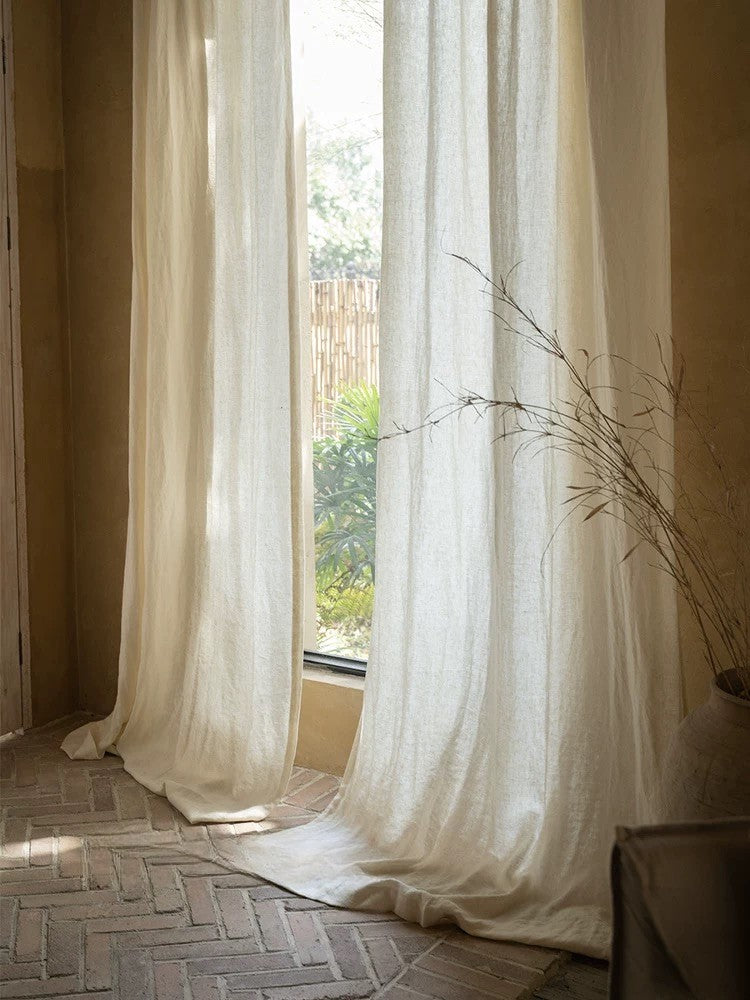
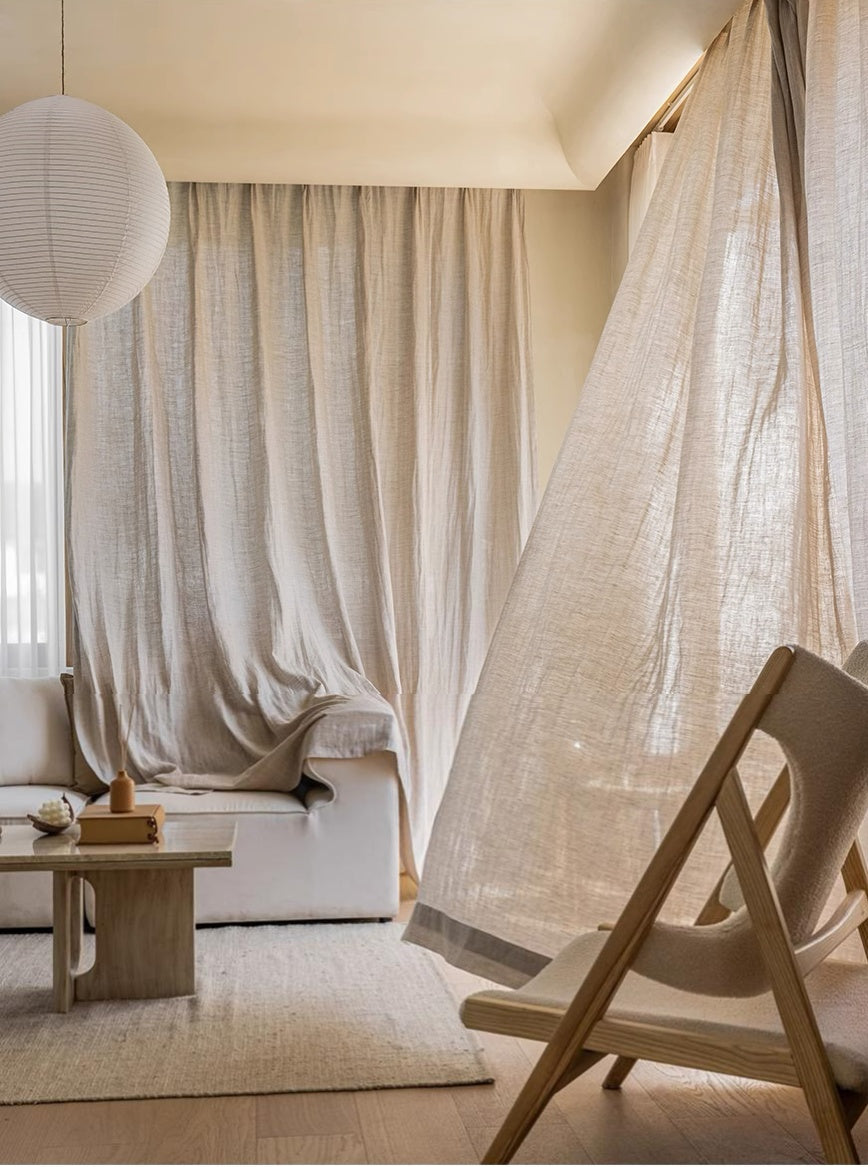
100% linen: let the weave provide the detail.
For natural-fiber texture, compare EaseEase Ivory White 100% Linen Curtains. A restrained color lets the yarns, weave and natural drape become part of the design. Choose any additional lining according to the light-control needs of the room.
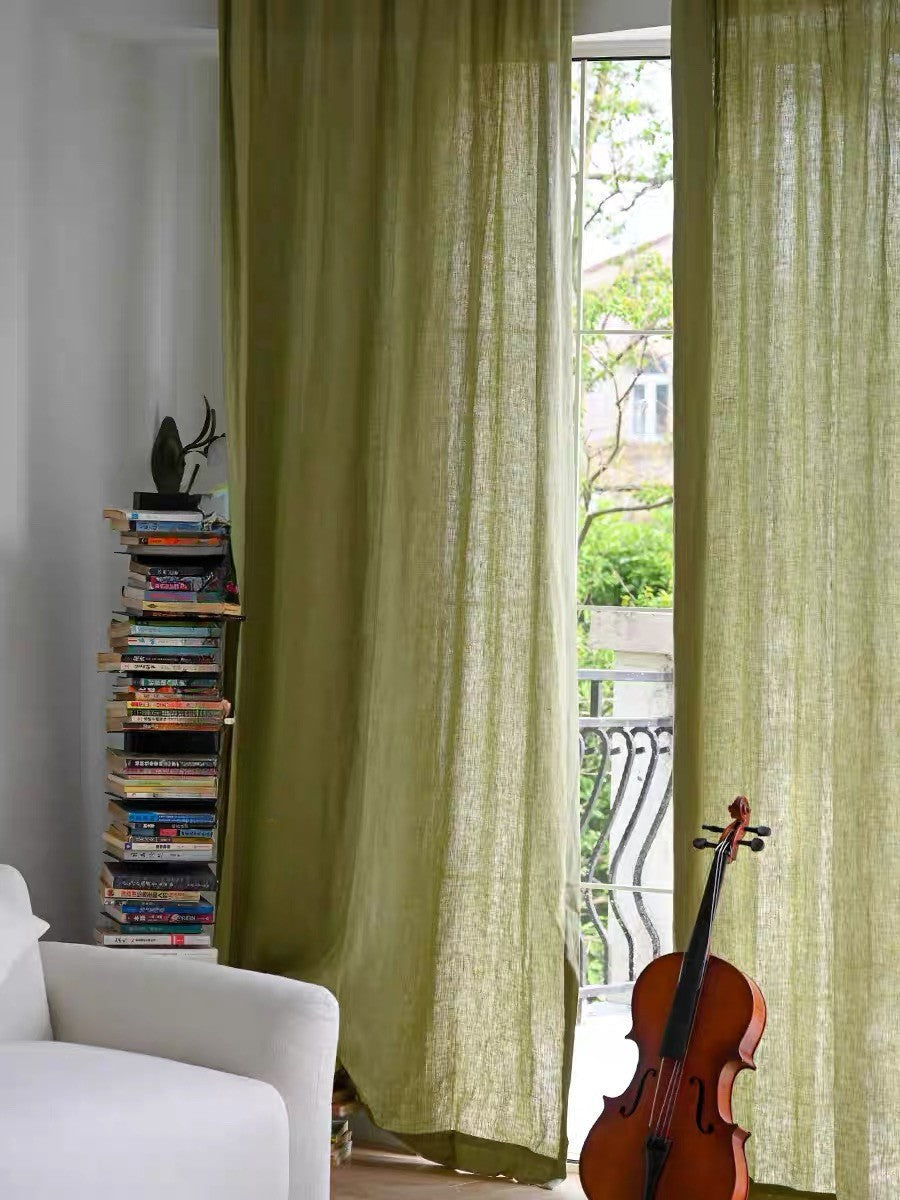
A textured linen blend: for a more substantial fold.
EaseEase Hunter Linen Blackout Curtains are specified as 10% linen and 90% polyester. They offer another texture and weight to compare. Adding lining changes both the weight and the gathered volume, so assess the tied-back position as well as the closed view.
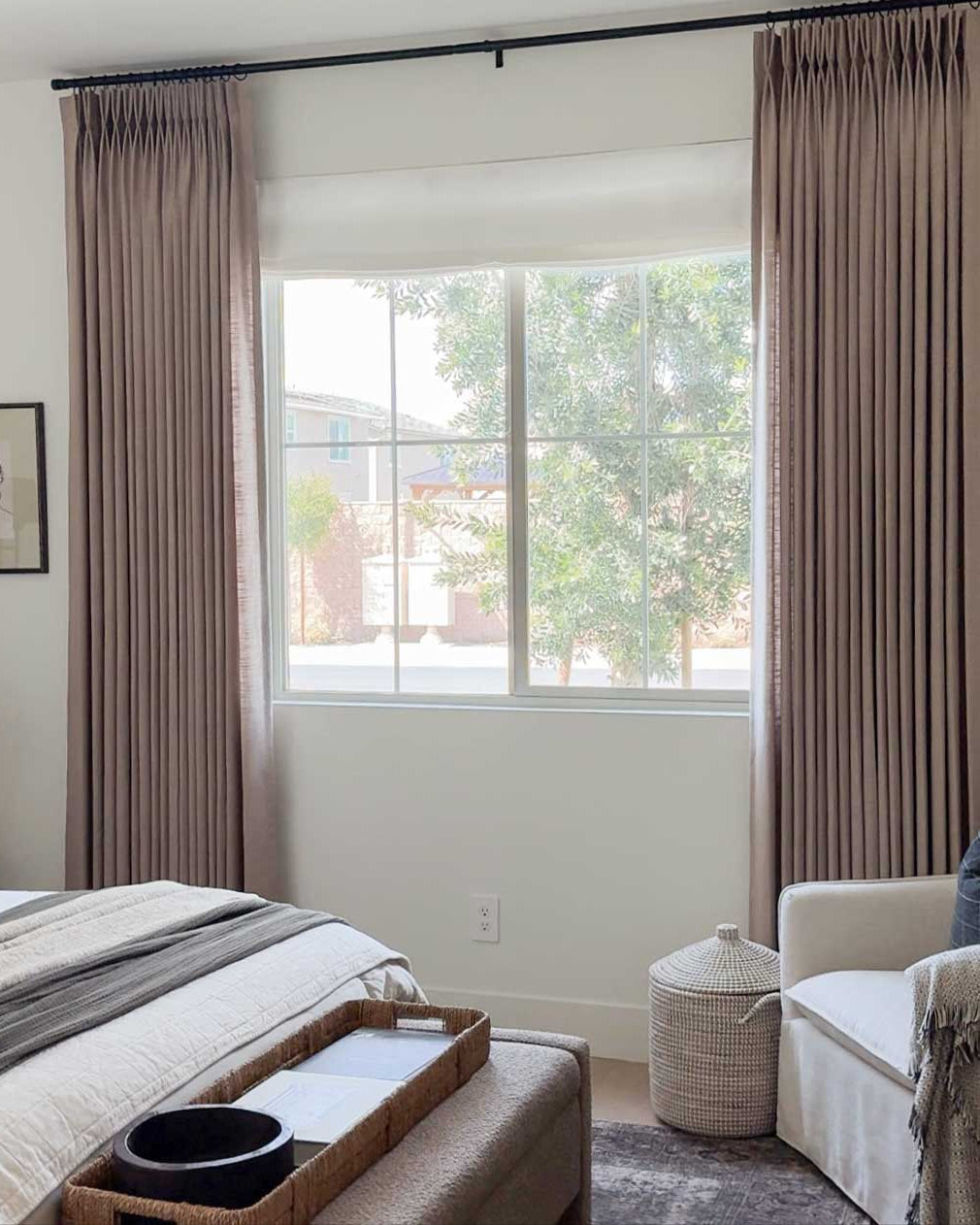
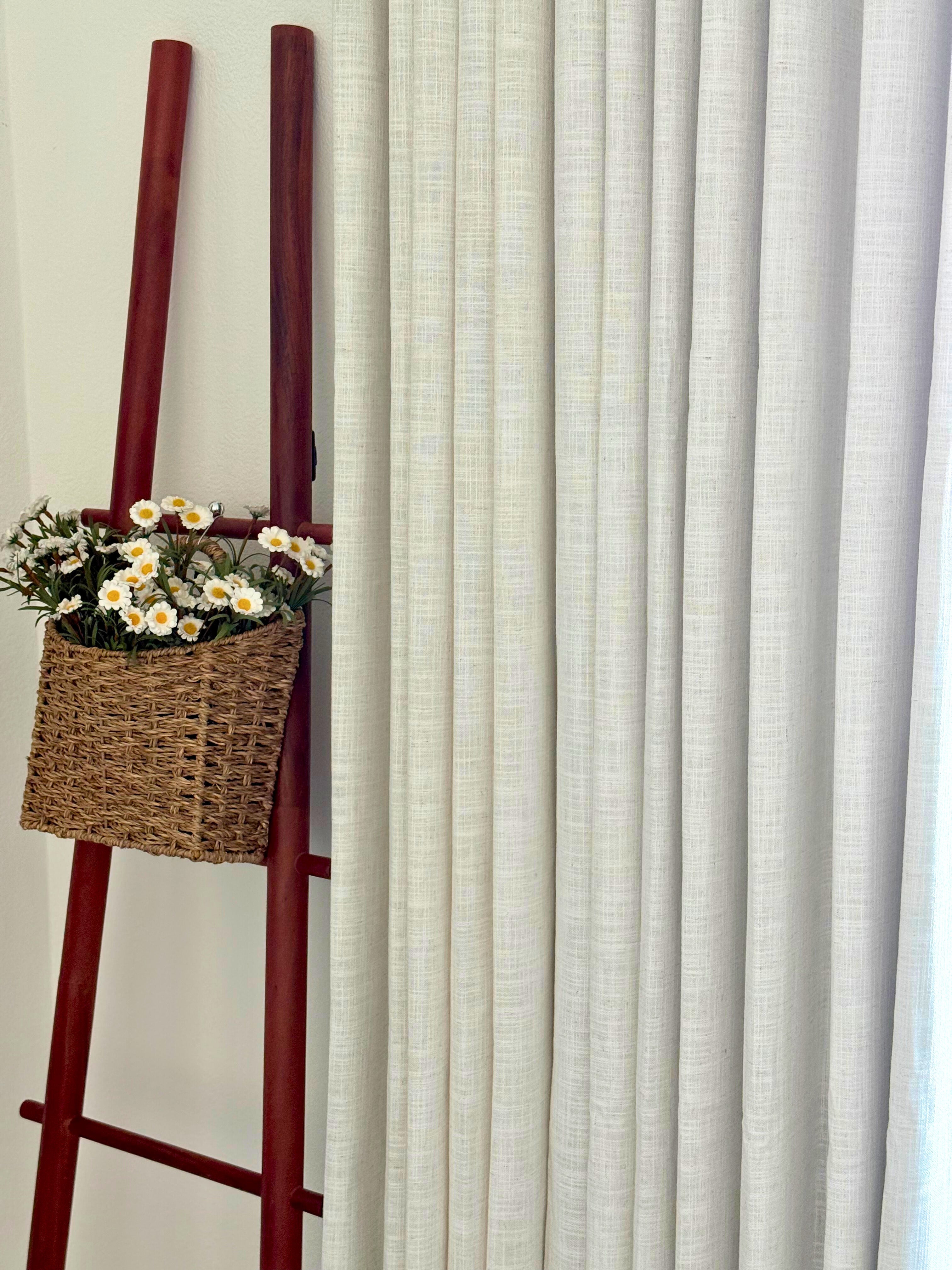
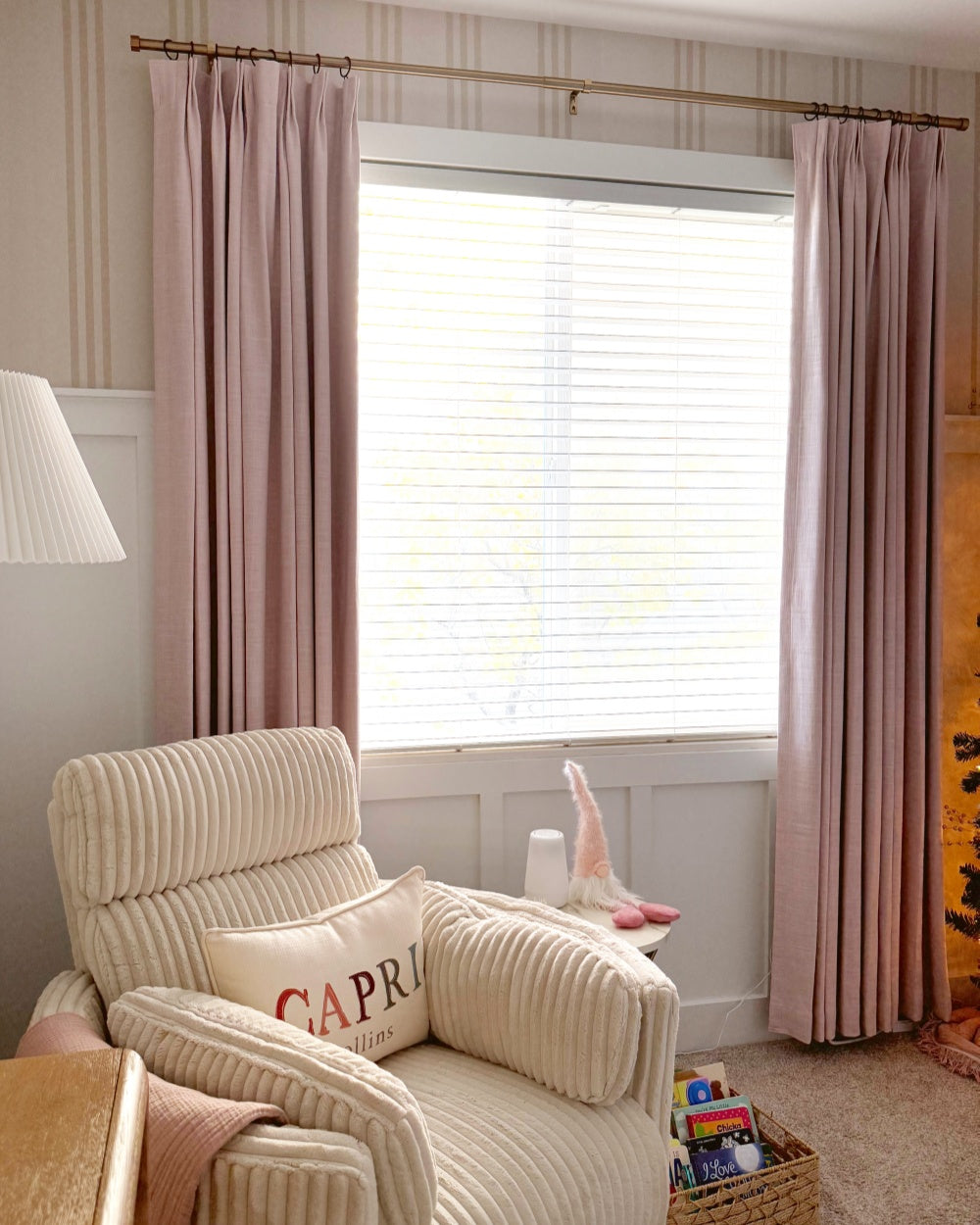
Pure linen, linen blends and linen-look fabrics are different choices. A natural appearance alone does not establish organic content, non-toxic performance or a particular environmental certification.
FREE FABRIC SAMPLES
Feel the Fabric Before You Frame the Arch
Compare sheers, 100% linen and linen blends in your own light. See the color, texture and thickness before choosing your custom drapery. Final drape and stack-back space still depend on the finished design.
Order Free Fabric Samples ↗Fabric samples are free; shipping applies. Available options and charges are shown on the sample page.
When fixed hooks do not suit the room, use a conventional rod or track
If you want smooth daily opening and closing, do not want to tie the curtains back by hand, or have a narrow doorway that should stay clear of projecting side fittings, consider a normal horizontal curtain rod or straight track.
Where the installation allows, a straight track above the arch or at the ceiling lets the curtains open to the sides and close across the entire window. The arch is revealed when the panels are open.
This does not trace the curve with fixed upper hooks. Instead, it prioritizes easy everyday use. Check the space above the arch, the fixing points and the room for the panels to stack on either side.
Not every arched window needs curtains attached along the curve. A well-planned reveal and an even, tailored drape can preserve the architecture just as effectively.
6. Before Ordering: Share More Than Width and Height
Start with a straight-on photograph of the complete window, its maximum width, total height from the bottom to the top of the arch, spring-line position and arch rise. Add the usable mounting depth inside the frame and close-up photos of possible fixing points at the top and sides.
Explain whether this is a fixed window, an opening window or a door people use. Include the handles and the door or window’s movement range in the photos.
Then describe your priorities: gentle daylight or minimal light leakage; curtains you are happy to tie back or convenient daily operation; children using the space; and any solar-charging or smart-control requirements.
Choose the structure first, then refine the measurements and fabric. That is usually more useful than selecting a color before finding out how the treatment can be installed.
For other specialty shapes, see our guide to triangle, arched and other odd-shaped window treatments. This article focuses on the practical choice between separate arched shades, a one-piece system and fixed-hook curtains.
Frequently Asked Questions
Are ceiling mounting, side-frame fixing and bracket mounting three separate motorized shade options?
No. The top ceiling-mount assembly is part of the design. Depending on the available fixing points, the installation can use the left and right window frames or suitable side-mounted brackets. These are not three mutually exclusive motorized versions.
Do both separate and one-piece motorized arched shades support smart control?
Yes. Both motorized designs discussed here support smart control and scheduling with the appropriate configuration. The key differences are the window coverage, system size limits and whether there is a join between separate upper and lower treatments.
Which option should I consider to reduce a light gap between the arch and the lower window?
If the size and shape allow, evaluate a one-piece motorized shade first because it avoids joining two separate shades. Perimeter clearances still need assessment; a one-piece design is not an automatic promise of a completely light-free installation.
Does the 108-inch width apply to every arched cellular shade?
No. It is a reference for EaseEase’s separate arched-top solution, not a universal limit for one-piece systems. Confirm the manual and motorized maximum widths and arch rises separately, along with the total-height limit of a one-piece design.
Can curtains installed along an arch slide open?
The contour-following curtains described here normally use fixed hooks. The upper attachment points do not slide; the fabric is gathered and tied back to expose the window. For sliding operation, assess a conventional horizontal rod or straight track instead.
Will tied-back curtains still cover some glass or doorway space?
Yes, they retain a fabric stack. A roughly 10%–20% allowance is an initial discussion reference, not a fixed per-side rule. Confirm the actual stacks and remaining clear width for the chosen fabric, lining and tieback arrangement.
Are fixed-hook arched curtains suitable for a narrow doorway in a home with children?
Do not decide from a styled photo alone. Check protruding hooks and holdbacks, potential bump hazards and whether fabric interferes with passage. Choose another mounting or shading approach if those details cannot be accommodated comfortably.
How often do the motorized shades need charging, and can solar charging help?
Typical use allows about 6–8 months between charges. A compatible solar charger can reduce manual charging, but its effectiveness depends on sunlight, shade size and operating frequency.
A Design That Respects the Arch—and Your Everyday Routine
Customizing an arched window should answer more than “Can this shape be made?” It should also explain where light might enter, how the treatment opens, how much space the gathered fabric takes and whether the mounting affects access.
A separate arched-top shade preserves flexibility below. A one-piece motorized cellular shade prioritizes reducing the join between upper and lower coverage. Fixed-hook curtains bring a soft outline to rooms where tying back the fabric suits daily life. A conventional rod or track remains a practical alternative when sliding operation matters.
The right arched window treatment respects both the architecture and the way you use the room.
EaseEase Curtains brings affordable custom curtains and shades to specialty windows, with made-to-measure options and thoughtful design guidance rather than a one-size-fits-all answer.
Send Us Your Arch. Let’s Find the Right Fit.
Share a front-facing photo, width, total height, arch rise and photos of the mounting areas. Tell us about your blackout, daily operation, doorway clearance and smart-control needs. EaseEase will help you compare separate shades, a one-piece cellular design and custom curtains.
Affordable Custom Curtains & Shades · Made to measure · Complimentary design guidance